Love Sourcing: Finding sustainability through the intangible
Republishing, Originally published in 2021 Design Museum Everywhere

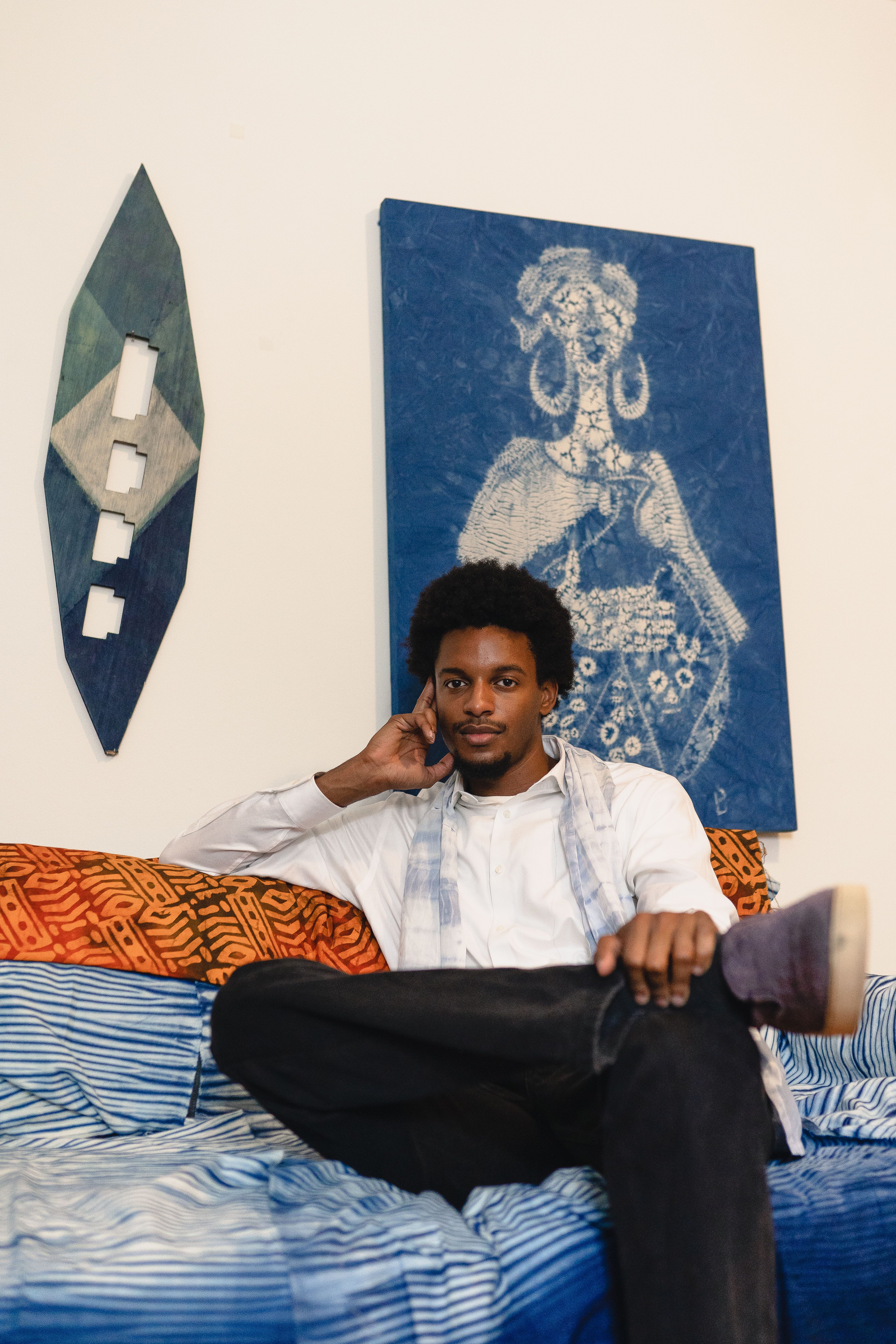
One year ago, my mother gifted me a vibrant, orange and brown, hand dyed batik cloth. It was made by her friend, a 5th generation Ghanaian master batik dyer. The cloth travels with me everywhere. I use it to adorn my living space and occasionally I wear it myself. In my family tradition, living a good life includes living with beautifully crafted objects. The value each object holds is augmented by the intangible experiences and memories attached to them.
It is just as Art Critic Seoutsu Yanagi describes in “The Beauty of Everyday Things”: the importance of living with beautiful everyday objects is to experience a sense of content. Though I am a young Black man living in the height of a climate crisis so threatening, so urgent and so ugly, I have a right to live a life with beautiful things. Responsibility for the climate crisis is frequently placed on the shoulders of the everyday person. Communities are encouraged to use less, recycle more, and minimize our carbon footprint. While these are good suggestions, it is existing ways of design thinking that need to be critiqued. The climate crisis has been caused by design that supports the relentless exploitation of our environmental, human, and material resources. To me, design is the process of discovery, healing, adding value, and developing relationships.
My understanding of design theory and material culture comes from everyday people. My grandfather learned to create his own tools. When my favorite childhood blanket became too small for my body, my mother repurposed it into a pillow. My father taught me how to build my own clubhouse from discarded plywood. When one of my favorite shirts suffered a spaghetti stain, I overdyed it to give it new life. My unconventional education in design allows for a synthesis of personal experiences into a design technique and aesthetic that supports my own vision of design in the post climate crisis future.
A large part of my design process is deconstructing imagined objects and processes, in order to determine how to effectively use energy and materials. When designing an object or process, I ask myself what is necessary for the object or process to be relevant and useful in the post climate crisis future? There are thousands of physical materials available to create with but there is only one material that is truly sustainable.
Love.
Love that is composed of intention, care, compassion, and unbounded empathy towards our environment and the users we serve with our designs. There was a day that I was sitting in my room determining my next steps in design; formal education, notwithstanding. I gazed at the batik dyed cloth my mother had given me and realized I was looking at the answer. I knew that if I studied and mastered a specific step in the process of making textiles, with an eco-conscious, love-forward approach, I would be able to traverse a multitude of industries. From furniture design, automotive design, to fashion. The more I researched, the more I became aware of the accessibility barriers to learning about design. I had the opportunity to visit a traditional textile artisan fair in Mexico City where I connected with talented designers, artisans, and artists from around the globe. Getting to know them and their practices, I was inspired to research the integration of traditional crafts and contemporary design.
Shortly after graduating from Howard University, with a B.A. in Political Science and Philosophy, in 2020 at the start of the pandemic, I moved to Seoul, South Korea, as a Henry Luce Scholar. I spent 10 months there conducting market research with a focus on design and traditional crafts practices in South Korea. I was able to observe the lineage and cultural transformation of crafts in that environment. I initially had come to Korea with the intent of focusing on how craft objects, particularly soft goods, were made. My goal was to learn traditional and contemporary methods of designing that promote healing – the self and the environment.
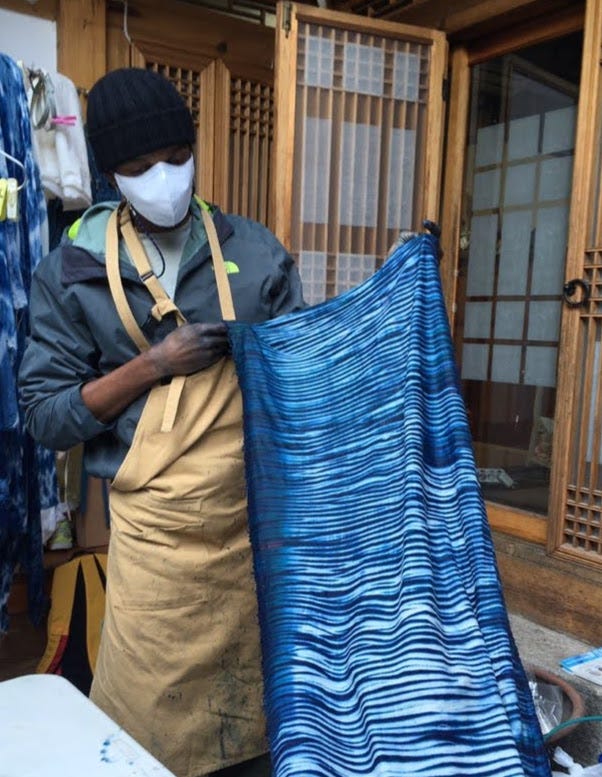
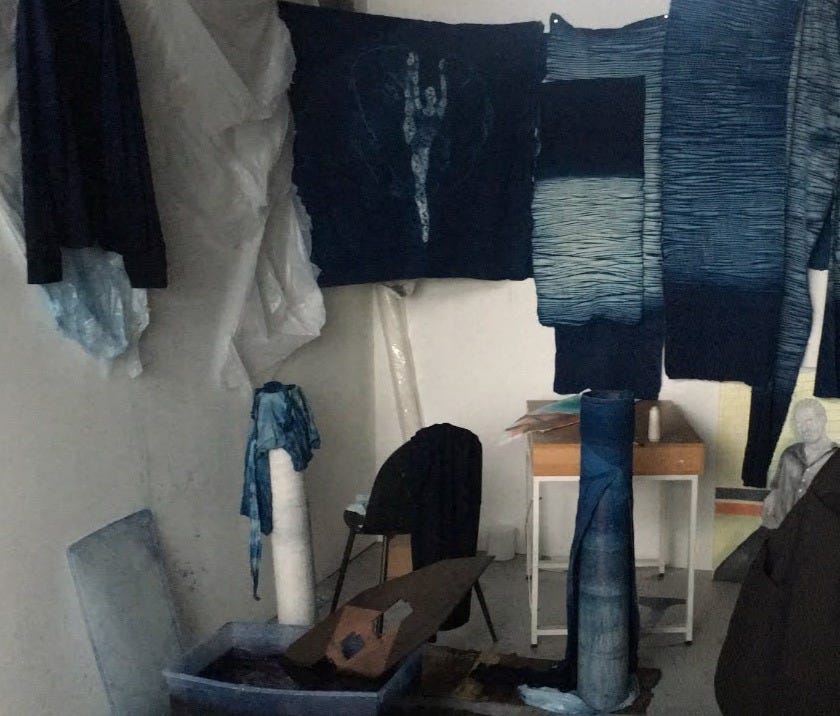
I spent much of my time adorning textiles with natural indigo dye and traditional South Korean embroidery techniques. These methods of adorning beautiful objects incorporate biodegradable materials, and appreciation for the material used. As an Artist and Designer the challenge of getting the holders of my handiwork to truly appreciate the object beyond materiality is a difficult one. Surveying traditional crafts, that had lasted hundreds of years, to determine what would sustain this appreciation seemed like the obvious answer.
But great design still needs to meet adapting modern needs. I conducted a market analysis of South Korean fashion trends and styles. Based on my research I designed a modern version of a men’s Hanbok for daily use, a traditional South Korean garment. I designed the garment to be suitable for travel to reflect my practice as a traveler traversing a globalized world. I taught myself how to make the techpack, 3D patterns, material sourcing; and carried out the remainder of the project to finish garments with the help of a local seamster.
Value lies in the practice. Materials aren’t inherently valuable; it is our relationship to the material that gives it a perceived value. Growing up, popular American media exposed me to the suggestion that fulfillment came from amassing as much as one could stuff into their home; whether it held sentimental value or not. This practice is inherently harmful towards the environment and our perceptions of use and ownership. Yanagi’s belief was that the appeal of using a beautiful object is that you come to love the practice of engaging with the object.
For example, tea ceremonies in South Korea and Japan have become synonymous with the vessels in which tea is consumed.
Materiality holds less importance when there is something intangible attached to the material such as emotions and memory. These intangible materials are key components of my design practice and sustainability research. After reading “All About Love” in which Bell Hooks describes her journey to understanding love, I was reminded that love is practiced in all aspects of life; including design. While material qualities and their impact on the earth are important considerations, deep feelings – love in particular –are the only things that are positively sustainable. Then how do we communicate love through design and creation?
From observing master artisans, the answer seems to be spending time with the object, slow making, and attention to detail. Sew to make sure every thread is in its right place. Unbind as opposed to cut to preserve as much material as possible. This attention to detail communicates that the maker loved the process. As an Artist and Designer, who is concerned with communicating love, I hope that the person who holds what I make explores all of the details and loves it just as much if not more than me.
The mud dyed cloth that I have loved since my mother gifted it to me will eventually become an heirloom. The cloth will be transformed into an heirloom once I give it to my children or my grandchildren. I imagine sitting with them and wrapping them tightly in the cloth while recounting the numerous stories I’ve gathered over the years with the cloth. Alternatively I’ll use it to set the dining room table during special occasions. Regardless, the cloth becomes a medium by which I can communicate my love for them. They’ll sit and scan the numerous lines and patterns, and etch the texture and smell into their memory.
When I design an object I try to imagine a future in which the object will still have use. I believe, the more uses an object has, for expressing love, in the future the more valuable my designs become. When I design I always reference the heirloom objects around me; as an example of an object that has survived up to the present moment, and with care will continue to survive. Heirloom objects help Ethno-Archaeologists describe the values of previous societies. The techniques applied to the object teach them about the technology available, materials available, and even the values of the maker. Heirloom objects, in the way they are treated and practiced, display love as a value.
A loved, but damaged, textile can be given new life through a variety of mending techniques such as overdyeing or quilting. The object must be designed to allow the forthcoming generations to continue to mend, care for, and love the object through practice. The mending portion is a key component to the sustainability and insurance that the object survives into the post climate crisis future. While there are materials that, on their own, can survive several human life times over, their near indestructibility brings up environmental challenges; disposal of hazardous waste or the slow release of microplastics into the air and water.
Well designed objects should be able to reflect the needs and desires of the users, time, and environment. Materials that aren’t biodegradable and survive old ideologies require a complex system for recycling that would use more energy than natural cycles provide.
Mending translates the love, of the current user and allows for greater adaptability and change. Even if the original designer and user isn’t there, these marks and stitches serve to communicate instructions on how the object can continue to be used. Even if this is not possible, the physical material choice should allow it to decompose safely. The childhood blanket, now pillow that I have, was the first textile that I consistently lived with. It served as my mediator for sleep until I reached adolescence. Even then, I still held the memory of the blanket. When it’s original purpose no longer served me well, my mother was able to manipulate it to serve a new need of mine. This example of adaptable design, mending, and love in practice; that makes room for the object to continue to have use in the future. Even if the blanket doesn’t make it to another user, the natural and chemical free materials make it clean enough to be safely recycled.
It is my goal to create an object where my love for design and making is communicated and then transferred through the object to the user.
The presence and awareness of love encourages the user to engage with my designs continuously in a practice, ritual, or ceremony. This develops a relationship between user and object. Supporting continued use of the object. The moment the object breaks or becomes dysfunctional, mending takes place, and continues to strengthen the relationship and intention that will carry the object into the future. My own design journey has had unexpected lessons. I realized that my design, that involves dyeing and embroidery, isn’t making the foundation of an object. It is the designing of adornment. Dyeing breathes new or renewed life and color into the textile. Embroidery, with the right techniques, has fortifying and mending capabilities. The cloth my mother gave me will get damaged at some point, but this presents the opportunity to further adorn, fortify, and charge it with love.
I am suggesting that the future of design thinking should incorporate love and practice at each step of the process. At ideation, prototyping, making, creating instructions, and sharing. Love is the greatest tool that designers have at their disposal to create lasting and effective change.
Being a steward and designer of love will lead to well made and beautiful objects that give users a sense of gratitude and happiness. Designers should imagine an environment in which love permeates every area of life. In designing for this environment, I believe it is possible to find solutions to both day to day and larger systemic issues that threaten all life on the planet. In any discussion of sustainability and the future of design, love is essential to creating beautiful objects and problem solving.

(See my follow up interview on A Gathering Together: “Shaking Out the Trauma: Bakari Akinyele on Designing, Creating, and Healing”, by AGT EDITORS, December 22, 2023.
This is wonderful! I want to see stitches from your work up close